A Poetic Alchemy of Emotion and Identity
A FUSION OF
ANIMATION,
3D MODELING
TYPOGRAPHY,
VIDEO ART,
LAYOUT DESIGN,
AND
LIGHTING TECHNOLOGY

Six years ago, I began pouring my unspoken emotions into poems. It was an attempt to preserve these feelings, then strange and abstract, swirling somewhere deep within my mind. As I wrote, the intensity of these sensations grew, revealing a fascinating truth: my brain physically responded to different situations and emotions, each leaving its own unique imprint. I could even feel these spaces while writing them down, distinct shapes and areas within my head. This revelation sparked a desire to visualize these emotional landscapes in my art.
These looping videos represent the cyclical nature of these feelings, their constant ebb and flow. Each video depicts a specific brain, capturing its form and essence during a particular emotional state. The poems woven into the background act as visual narratives, further amplifying the emotions and spaces they describe. These spaces, in essence, represent snapshots of my own head at those precise moments.
My passion for typography led me to choose it as the language of my art. Not just because of its connection to poetry, but also because it has always served as a powerful tool for expressing my emotions and translating them into visual form. For me, typography transcends mere communication; it embodies the very essence of my feelings, shaping them into tangible forms. Often, it's not about reading the text literally, but about feeling its vibrations. While some words remain intentionally visible, inviting viewers to decipher them, the act of searching itself evokes another desired feeling: that of enigmatic mystery, of unspoken emotions and forbidden desires swirling within the head.
I aim to process data through coding and delve into its emotional nuances. Furthermore, I aspire to translate various types of poetry into visualizations using coding techniques. In my mind, these codes are programmed to construct a spatial representation of the poems. Each poem, each type of data, becomes a brushstroke in this ongoing creation. Poems transform into textures, emotions manifest as swirling colors, and the very code itself shapes the architecture of this emotional terrain. It's an intricate dance between logic and feeling, where the digital realm becomes a canvas for expressing the ineffable.
To complete the immersive experience, a soundscape composed of my voice reading the poems plays in the background, but at a frequency reminiscent of brainwaves during sleep. This choice reflects my belief that only in slumber can I truly access these spaces in their purest, most visual form.

The following poem, titled Formula, is a composition I created over the course of six years, capturing deeply personal, unspoken emotions that have profoundly influenced my creative process in this project. This body of work is intricately rooted in the emotional themes expressed throughout the poem. The poem is divided into four distinct segments, with each segment serving as the conceptual foundation for one of the four accompanying video artworks. Each piece translates the emotional intensity of its corresponding segment into visual and auditory experiences.
THEY ALL WEAR BURQAS,
AND INSIST I DO TOO.
IN SHADOWS DEEP,
WHERE SECRETS ACCRUE,
THEY WEAR THE BURQAS,
A MYSTIC HUE.
LOVING IN THE DARK,
THE LUST IN VIEW,
A HIDDEN INTERLUDE,
FORBIDDEN AND TRUE.
IN PROFOUND PONDER,
I SOUGHT TO UNVEIL,
THAT BENEATH OUR VEILS, WE’RE ALL HUMAN,
WITHOUT FAIL.
BREAKING THE CHAINS,
DISMANTLING THE WALL.
FOR ME NOT YOU,
I FIND THE POWER TO UNVEIL
FOR THE SODOMY,
AGAINST YOUR ACID HAIL.
MY VEINS, ONCE VIBRANT, NOW TAINTED WITH THEIR DARKNESS
MY HEAD, ONCE FILLED, NOW EMPTY AND STILLED.
IN PASSION DEEP, CONCEALED IN THE HUSH OF BLACKNESS,
YEARS RESTRAINED, A SILENT, ECHOING CHILLNESS,
A SCAR DROWNED IN BLOOD; A HEART’S DORMANT THRILLED.
THEY BRAND ME AS THE MINORITY’S FACE,
YET, I’M CERTAIN, THEY’RE NOT THE MAJORITY’S GRACE
ASSIGNED ROLES, EACH LABELED CASE,
BEHIND THE MASKS, WE SHARE A COMMON SPACE.

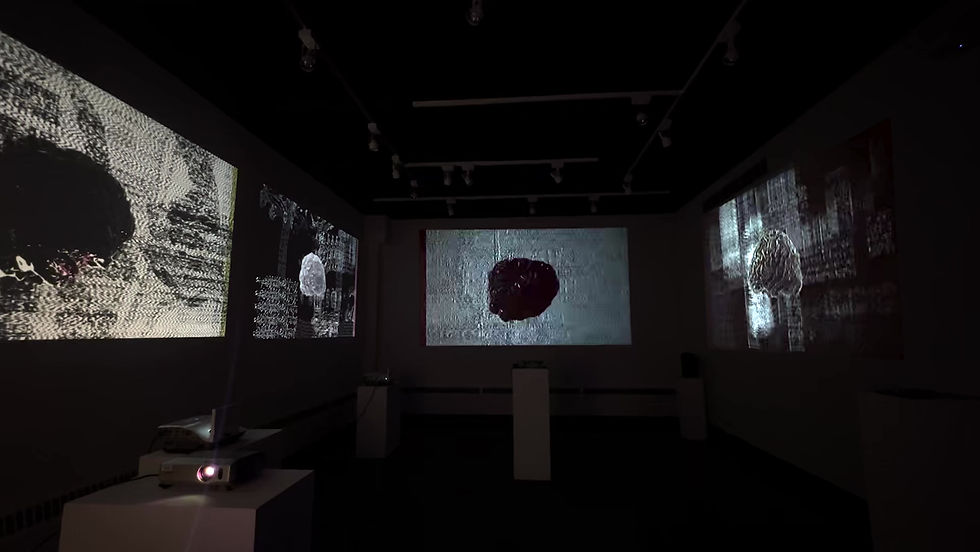


Furthermore, "FORMULA" engages with queer theory, discussing the fluidity and plurality of identities. The project goes beyond my own story, encouraging a reevaluation of conventional perspectives on identity formation and expression, thereby contesting static views on sexuality and gender. It emphasizes the evolving nature of queer identities through a multisensory tapestry of typography, looping videos, and a soundscape reminiscent of the subconscious state of sleep.
The looping videos portray the ceaseless ebb and flow of emotions that shape my inner world. Accompanied by poems, they offer windows into my soul, capturing fleeting moments of introspection and vulnerability. The integration of deep neural network-generated visuals throughout the gallery adds a compelling layer, further probing into the realms of cognition and emotion.
In essence, this project is a conversation with the viewer, a shared journey into my psyche and a broader meditation on the complexities of human consciousness. It is an exploration of how we perceive and construct our realities, inviting a contemplative engagement with the profound intricacies of emotion and identity. The FORMULA show, a dynamic interplay of technology, emotion, and artistry, employs looping videos to vividly portray the cyclical nature of emotions. Each video acts as a window into a specific brain, meticulously captured during a nuanced emotional state.
This precise portrayal offers an intimate view into my inner workings, making palpable the fleeting moments of emotional intensity that define human experience. Accompanying these visuals, poems integrated into the background serve as rich, layered narratives, enhancing the portrayal of complex emotional landscapes. These poems not only deepen the sensory experience but also invite viewers to traverse the contours of human feelings, portrayed as temporal snapshots that echo the constant shifts within my psyche.
The exhibition further incorporates advanced visualizations generated by deep neural networks, projected across the gallery space. These projections endeavor to materialize human thoughts, presenting them as intricate visual forms that challenge and expand our perceptions of cognition and emotional expression. This innovative use of technology underscores a central theme of the exhibition: the exploration of how our innermost thoughts and emotions can be externalized and understood through art.
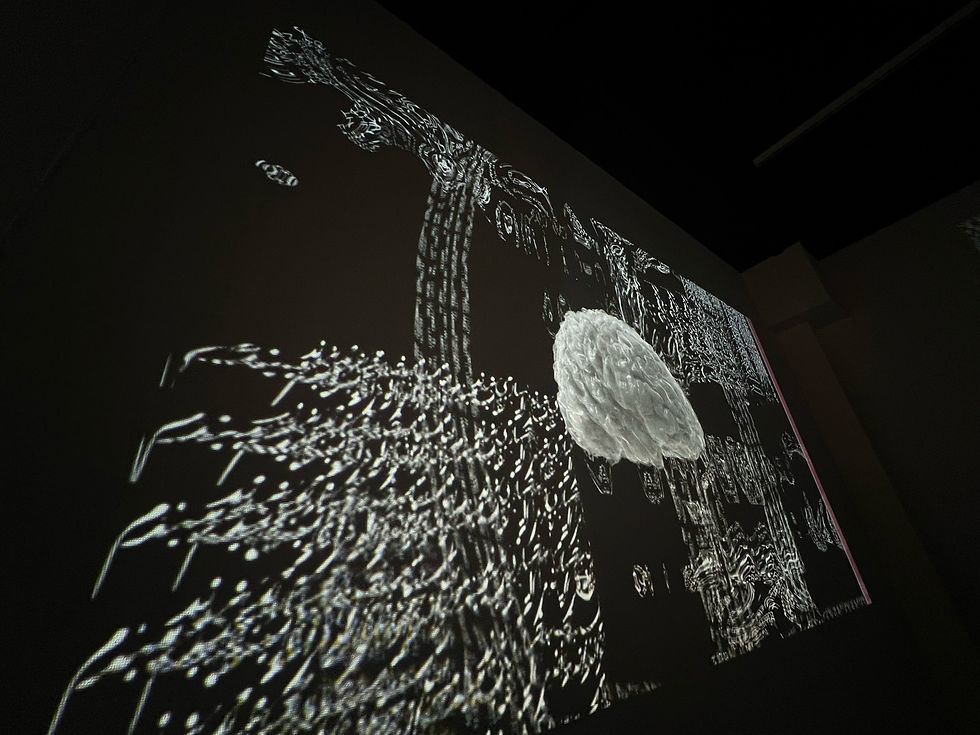


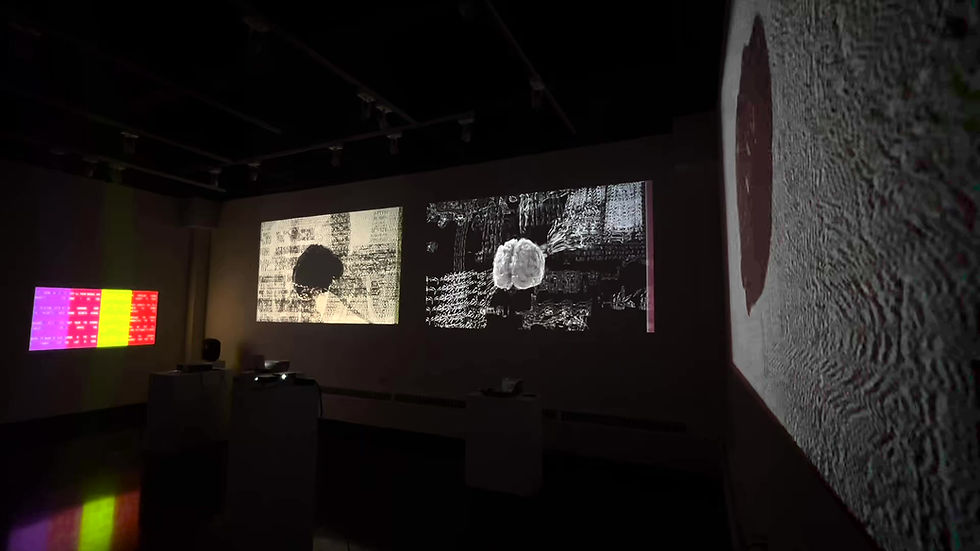
Typography, a cornerstone of my artistic expression, is employed not merely as a method of communication but as a formative element that shapes the emotional landscape of the exhibition. It captures the essence of feelings, converting abstract emotions into visual form. The typography in this project—deliberately varied in visibility—encourages a deeper engagement. Visible phrases invite literal interpretation, while obscured text prompts a more instinctual, emotional response. This interplay between clarity and obscurity mirrors the complexity of our internal worlds, often clear yet paradoxically mysterious.
The exhibition is further enriched by an immersive soundscape, which features recordings of my voice reading the poems, modulated to mimic the frequency of brainwaves during sleep. This auditory element is not just a background detail; it is a deliberate choice to evoke a state of introspection and deep reflection, akin to the vivid clarity sometimes found in dreams. It suggests that the truest understanding of our emotional and cognitive landscapes may come not while awake, but in the depths of our subconscious minds.
Together, these elements—video, poetry, neural projections, typography, and sound—create a multifaceted sensory experience that invites viewers to ponder the profound depths of human consciousness. The exhibition aims not only to showcase personal reflections on mental and emotional states but also to foster a broader dialogue about the nature of perception, reality, and the human condition. Through this immersive journey, viewers are encouraged to explore their own inner landscapes, confronting and embracing the complexities that shape our understanding of ourselves and the world around us. In this project each poem of four poems i wrote since six years ago is intricately woven into the fabric of my thesis show, capturing the essence and driving the narrative explored through each visual and auditory element.
These verses are not merely words on a page; they are the foundational pillars upon which the entire project is built, offering profound insights into the thematic and emotional layers that define this artistic endeavor. Each poem is associated with a distinct color, enhancing the sensory experience of the exhibition. As you navigate through the show or flip through the pages of the “FORMULA” book, you will encounter visual elements reflecting the specific color tied to each poem. This thoughtful integration of color not only enriches the visual aesthetic but also deepens the emotional resonance of each piece, creating a cohesive and immersive experience that mirrors the unique tone and mood of the corresponding text.


For this project, as I mentioned, each video and brain art piece is inspired by a section of the Formula poem. To create a cohesive visual identity that guides the audience through the show and enhances their experience, I decided to assign a distinct color bar to each video. These color bars serve as visual markers for each section. In the opening part of the show, the poem is projected in four segments, each represented by a different color. These colors correspond to the color bars featured alongside the videos, creating a clear and unified visual narrative throughout the exhibition.


For this project, my main goal was to elevate the overall experience for those attending the show, and I wanted to leverage every aspect of my graphic design expertise to achieve that. One of the key areas I focused on was layout design, which led me to develop a comprehensive visual package for the project. I decided to create an entire book dedicated to FORMULA, where each page would highlight a specific section of the poem, with its title and corresponding design.
To bring the essence of the poem to life, I incorporated both typography and calligraphy, using Farsi to emphasize the poem's cultural and linguistic origins. Showcasing the originality and authenticity of these poems was incredibly important to me, and I wanted to ensure that this was reflected in every detail of the book’s design. My process was thorough and involved using various techniques to create visuals that were both expressive and meaningful.
In designing the book, I explored several methods to achieve the ideal aesthetic for each page. These techniques included printmaking, particularly silkscreen printing, laser cutting, hand-painting, and drawing with Ecoline colors, as well as incorporating 3D modeling. By experimenting with these diverse techniques, I was able to develop a unique and intricate design for each section of the poem, ensuring that the book not only complemented the exhibition but also stood as a work of art on its own. Through this, I was able to bring the full scope of my graphic design skills to the project, creating a visually immersive and culturally authentic experience for the audience.


Historical Influences:
The “FORMULA” project draws upon a rich history of conceptual and digital art, influenced by movements such as Constructivism and Bauhaus for their emphasis on geometric forms and functional design, as well as Concrete Poetry, where the visual arrangement of text is as important as its meaning. The use of mathematical symbolism and typography also echoes the influence of the Typographic Modernism movement, which sought to bring clarity and simplicity to graphic design through the precise arrangement of type. The use of 3D animation and digital techniques connects the project to contemporary digital art practices, which have roots in the video art movement pioneered by artists like Nam June Paik, who explored the artistic potential of video as a medium in the 1960s and 70s.

Structural Concepts:
The structural concept of “FORMULA” revolves around the exploration of identity through mathematical and typographic elements. The project employs a modular approach, where each 3D brain represents a personal poem. This approach can be seen as an extension of the modular design principles found in both modernist architecture and digital media, where components can be rearranged or repeated to create a cohesive whole. The looping nature of the videos suggests a cyclical structure, referencing the repetitive yet evolving nature of personal identity and thought processes. For me this is aligned with the iterative design concept, where repetition is used to refine and evolve the final output.

Technique and Process:
The technique used in “FORMULA” involves the creation of 3D animations that integrate typography with brain imagery, symbolizing the connection between language and cognition. The process involved digital modeling in software such as Cinema 4D and other animation tools like After Effects, where mathematical forms and typographic elements were meticulously crafted and animated. The choice of looping video as a medium allows the work to continuously present itself, reinforcing the thematic exploration of ongoing identity formation. The use of digital tools in the design and animation process highlights the project’s connection to contemporary digital art practices, which involve the manipulation of virtual space and time to create immersive experiences.


Conclusion:
FORMULA is not just an art project; it’s a reclamation of voice. Growing up in Iran, I learned to live in the in-between, between visibility and erasure, freedom and silence, belonging and isolation. This tension became my creative catalyst, fueling a desire to make the intangible visible and the suppressed undeniable. Through this project, I sought to create more than an experience; I aimed to craft a mirror, one that reflects the fluidity of emotion and identity in all its complexity. By blending animation, 3D modeling, and neural network-generated visuals, I believe this project invites viewers to step into a space where emotions cycle endlessly, where boundaries blur, and where personal narratives intertwine with universal ones. It’s a space that resists definition, just as identity does. At its heart, FORMULA is an offering, to anyone who has ever felt unseen, unheard, or confined by expectations. It’s a reminder that our stories, however fragmented or quiet, hold power. It’s proof that art can be both refuge and rebellion, a place to feel deeply and a platform to speak freely. This is my story, told through the fluid language of memory, emotion, and technology, and I hope it resonates as a space for others to find their own.
References:
Eshtiaghi, Arman. "FORMULA: A Poetic Alchemy of Emotion and Identity." Master’s thesis, Northern Illinois University, 2024. Huskie Commons. https://huskiecommons.lib.niu.edu/allgraduate-artistry/12/.
“The Principles of Constructivism,” in The Bauhaus Group: Six Masters of Modernism by Nicholas Fo Weber. Yale University Press, 2009.
Higgins, Dick. “Intermedia.” Something Else Press, 1966.
Eskilson, Stephen J. “Graphic Design: A New History.” Yale University Press, 2012.
Nam June Paik. “Electronic Superhighway.” Smithsonian American Art Museum, 1995.
El Lissitzky. “The Constructor.” The Museum of Modern Art, 1924. A seminal work in Constructivist art, emphasizing the use of geometric forms and a functional approach to art and design.
McLuhan, Marshall. “Understanding Media: The Extensions of Man.” McGraw-Hill, 1964. Explores the impact of media on human perception, relevant to the use of digital and video art in contemporary practice.
Moholy-Nagy, László. “Painting, Photography, Film.” The MIT Press, 1969. Discusses the integration of different media in the creation of art, particularly relevant to the use of typography and video in “FORMULA.”
Gombrich, E.H. “Art and Illusion: A Study in the Psychology of Pictorial Representation.” Princeton University Press, 1960. A key text on visual perception and representation, which relates to the conceptual and structural elements of “FORMULA.”
Tufte, Edward R. “Envisioning Information.” Graphics Press, 1990. A foundational text on the visualization of complex information, relevant to the project’s use of mathematical symbolism and typographic design.